
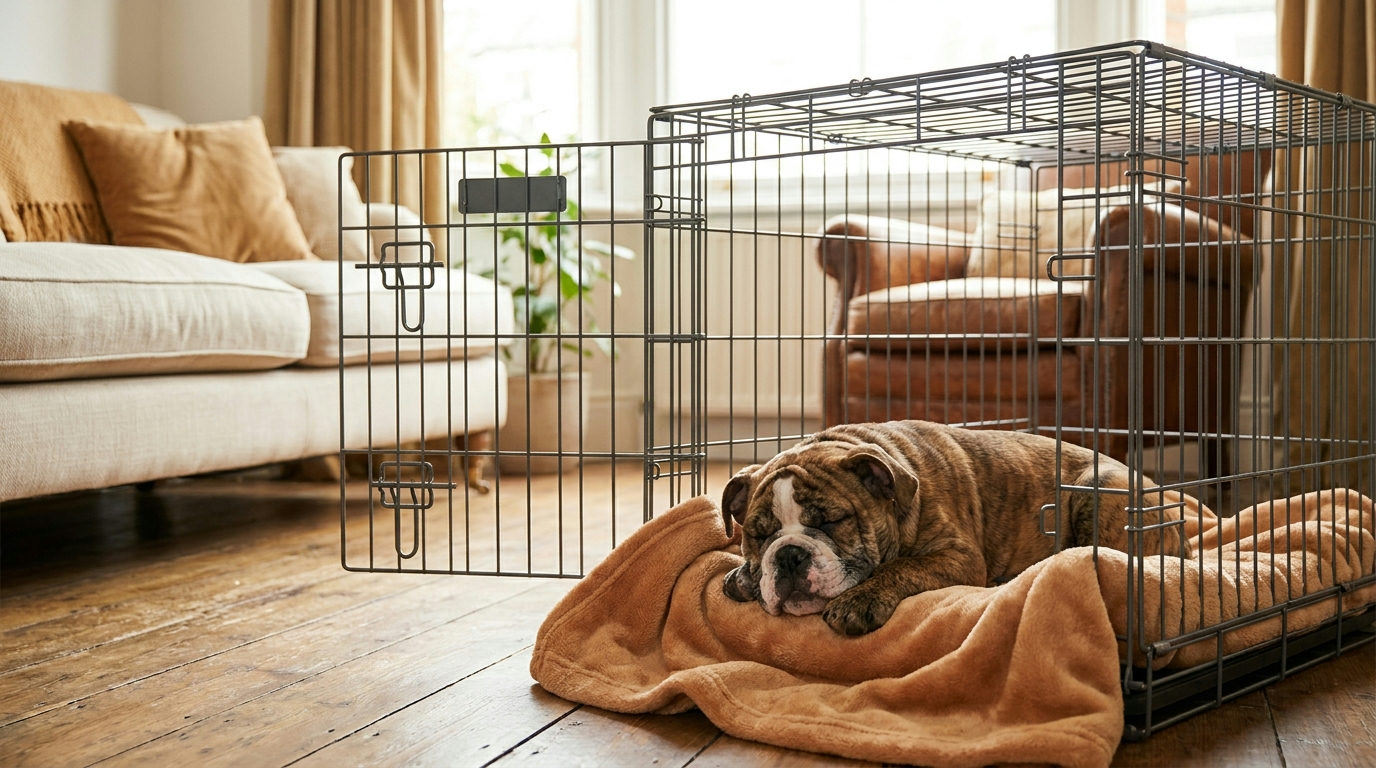
A bulldog crate training safe space begins with a suitable setup and a comfortable introduction. A crate is equipment, not a guarantee that your Bulldog feels safe. Before closing its door, check the space, placement, supplies and the dog’s response. Some dogs need a different arrangement or professional help with confinement.
This is general training information, not veterinary advice. Ask your vet about your Bulldog’s health, suitable activity, toileting needs and any concern about breathing or confinement. Do not shut the dog in to test how long it will tolerate distress. The checklist below helps you prepare and evaluate the home arrangement before relying on it.
Define why you want to use the space
Write down the intended use: an accessible resting place, a gradual introduction to confinement or another task discussed with a professional. Keep medical recovery and travel questions separate. A home crate arrangement does not automatically meet transport requirements, and prescribed recovery restriction needs the treating vet’s instructions.
Identify when someone will be available to supervise the introduction. If your immediate need is a long absence before training has begun, arrange suitable care instead of treating a new crate as an instant solution. A puppy’s care requirements and an adult dog’s established routine can differ. Discuss the actual household situation with the veterinary or training professional.
Keep one alternative arrangement in mind, such as an appropriately prepared pen or room, to discuss if the crate is unsuitable. Do not assume that every gate or pen is automatically safe either. The alternative needs its own equipment, access and supervision checks. The important question is what arrangement fits this dog and purpose.
Check the physical space on the actual equipment
Dogs Trust’s crate and pen guidance recommends sturdy, correctly assembled equipment with room for comfortable movement and stretching. It also advises access to fresh water and a gradual introduction. Compare the actual crate with your Bulldog’s needs rather than selecting only from a size label or photograph.
Assemble the equipment according to its instructions before inviting the dog near it. Check the base, door movement, fastenings and any removable parts. Do not use a damaged component or an improvised attachment without appropriate advice. The first test is whether the equipment is ready for use, not whether food can persuade the dog to enter it.
Plan to reassess fit as a puppy grows. Keep the product instructions and measurements on the equipment card. If you are uncertain about suitability, ask the seller and a qualified professional rather than declaring the largest or smallest option universally best. The intended home use matters alongside the individual dog’s dimensions and behaviour.
Choose a practical room position
Look at the spot during the times you intend to use it. Note direct sun, nearby heating equipment, household traffic and noise. A quiet-looking corner in the morning can become a busy route later. Ask the vet about environmental considerations for your Bulldog instead of assuming that any covered enclosure is comfortable.
Check access for people and pets. Can the dog enter and leave without another animal blocking the doorway? Can a caregiver reach the equipment safely without leaning awkwardly over it? Move nearby cords and objects that could be reached or pulled inside. Do not place the crate where children routinely crowd around the opening.
If you use a cover, follow appropriate equipment guidance and check the arrangement carefully. Do not treat a cover as a remedy for heat, breathing discomfort or distress. An observation about the room should lead to a suitable adjustment or professional question, not conceal a problem so the space looks more den-like.
Select supplies for this dog’s behaviour
Ask about suitable bedding, water access and any enrichment item for the individual dog. Read the maker’s instructions and supervise unfamiliar items appropriately. A chew or toy recommended for a different animal may not suit your Bulldog’s chewing behaviour. Remove damaged items and seek advice about anything you are unsure can be used safely.
Keep food used for the introduction within the agreed feeding plan. Do not add an unlimited supply of treats to make the crate attractive. Ask the vet how to account for training rewards, especially if a diet or other health issue affects food choices. Write the selected reward and any restriction on the care card.
Do not overload the space. Place the intended items so you can see whether the dog has room to move comfortably. If an item repeatedly spills, shifts or obstructs the doorway, review it. The setup should support the purpose you wrote down, not become a display of every accessory available in a catalogue.
Start with an open-door investigation
The RSPCA’s crate guide describes a positive introduction with the door secured open and gradual progress. It states that crates should not be used as punishment. Let your Bulldog investigate voluntarily and avoid pushing, carrying or trapping it inside to complete the first exercise.
Prepare the open door using the supported method so it cannot swing unexpectedly. Stay available while the dog investigates the surrounding area. Reward a comfortable approach where appropriate. If the dog does not enter, the result is information about the current stage, not failure that requires closing off its escape route.
Keep the first task narrow: comfortable approach or investigation, depending on what has already been established. You do not need to close the door during the same session. Record whether the dog approached, entered, left or avoided the area. Those observations help a trainer decide what to change without promising a particular completion date.
Separate resting from practising confinement
An open resting place and a closed enclosure ask different things of the dog. Being willing to collect a treat inside does not establish comfort with a moving door, a latched door or a person leaving. Ask your trainer to help with a gradual plan when you reach those stages. Do not add several new demands at once.
VCA’s confinement guidance discusses gradual reward-based practice and advises professional help when a dog shows significant distress. It also notes that toileting needs can explain changes during rest. Do not assume that vocalising always means the dog is trying to manipulate the caregiver.
If you notice persistent vocalising, escape attempts, inability to settle or another concerning response, end the difficult exercise safely and speak to the vet or qualified behaviour professional. Avoid making a rule that the door must remain shut regardless of the dog’s welfare. A possible medical or behaviour problem needs assessment, not a contest over who gives in.
Write a care note another person can follow
Include the purpose, current comfortable stage, equipment instructions and clinic contact. State whether the door should remain open and which tasks have not yet been practised. A sitter should not infer permission for prolonged confinement from seeing a crate in the room. Explain the actual care arrangement directly.
Add toileting, supervision and rest arrangements agreed for your dog. If the household cannot provide the needed care, discuss alternatives before leaving the animal. Do not borrow a universal number of hours from a blog or treat another Bulldog’s routine as proof that yours can cope with the same absence.
Review the setup before relying on it
Walk through the checklist again: suitable equipment, practical location, appropriate supplies, comfortable voluntary investigation and a shared care note. Mark unanswered questions clearly. Seek help with a stage that remains difficult rather than decorate the space and assume the training question has been resolved.
A bulldog crate training safe space is a prepared arrangement that you continue to evaluate. Begin with the equipment and room checks, then allow a positive open-door introduction. Keep confinement practice gradual and individual. The next useful step is one comfortable interaction or a specific professional question, not a claim that the crate itself guarantees calm.