If you’ve ever watched a bulldog lean into the lead on the way to the park, you’ll know how much a stocky little dog can pull. That’s why the bulldog harness vs collar question comes up so often. This guide is a practical walk-through for everyday owners: what each option is, the main harness styles, how to measure and fit one on a broad-chested dog, how to introduce it, and what to ask your vet. It doesn’t try to settle the question for every dog, because your own vet is the best person to do that.
Disclaimer: This content is for informational purposes only and is not a substitute for professional veterinary advice. Ask your veterinarian which walking equipment suits your individual dog.
Harness or collar: the short version
A collar sits around the neck. A harness sits around the chest and shoulders. Many owners use both for different jobs: a flat collar to hold an ID tag, and a harness to attach the lead on walks. Which setup is right for your bulldog depends on their build, their health, their age and how they walk.
The American Kennel Club publishes general guides to both options. Its collar or harness guide and its guide to choosing a harness are worth reading before you shop. Bring what you learn to your next vet visit and ask what they would suggest for your dog.
For background on the breed’s build, see our guide to bulldog breathing problems.
What a collar is good for
A flat collar is a convenient place for an ID tag, and many owners keep one on at home. Fit it so it feels comfortable, and check it regularly in case your dog grows or changes weight. Many harnesses also have a ring for a tag, so some owners skip the collar when they’re out.
Whatever you choose, keep some form of identification on your dog. Microchip details are worth keeping up to date too, because a tag can come off.
Types of harness explained
Harnesses come in a few main styles. Each suits different dogs and different walking habits, so it helps to know how they differ.
Back-clip harness
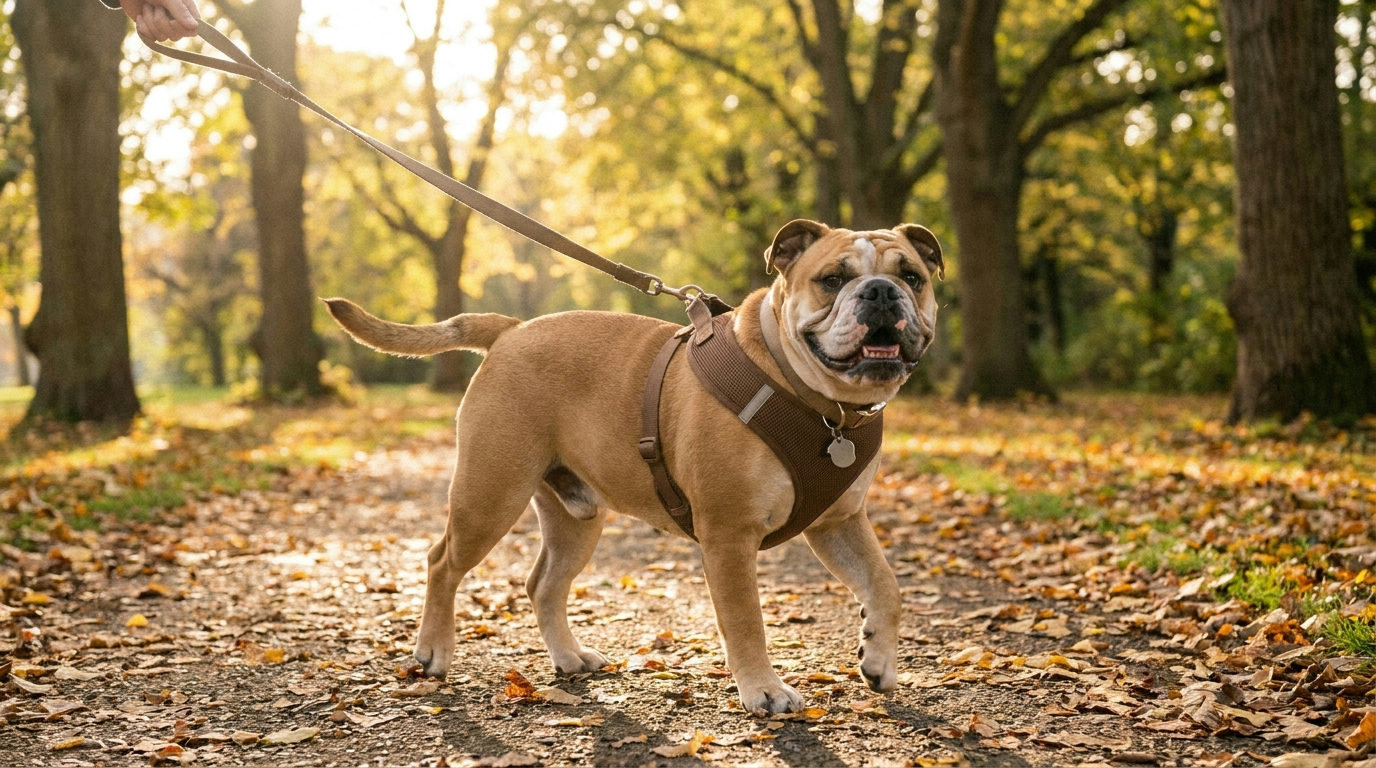
The lead attaches on top of the back, between the shoulder blades. These are simple to put on and easy to walk in. For a calm walker, a back-clip Y-shaped harness is a common starting point.
Front-clip harness
The lead attaches at the chest. Owners often try this style while working on loose-lead walking, because the lead turns the dog gently towards you when it tightens. When you try one on, check that the straps sit clear of the throat and don’t restrict the shoulders.
Dual-clip harness
Some harnesses offer both a front and a back ring. That gives you flexibility: front clip while you work on loose-lead walking, back clip once your dog walks nicely.
Step-in and over-the-head styles
The AKC harness guide describes step-in designs, where your dog steps into the straps before you clip them at the back, as well as over-the-head designs. If your bulldog has a broad head, a step-in style or a harness with an adjustable neck opening may be easier to put on.
How to measure and fit a harness on a bulldog
Bulldogs have a broad chest, thick neck and short back, so standard size charts don’t always match. Good fit matters more than the brand name. Here is a simple routine you can follow at home.
- Measure first. Use a soft tape to measure the widest part of the chest, just behind the front legs, and the neck where a collar would sit. Use the chest measurement as your main guide when reading size charts.
- Look at the neck strap. Many owners look for a design where the strap sits low, near the chest, rather than across the throat.
- Try the two-finger check. A common rule of thumb is being able to slide two fingers between the harness and your dog’s body.
- Look behind the front legs. Make sure the straps sit smoothly there. Padded or mesh straps can feel softer.
- Test for escape. With the harness fastened, step backward as your dog moves forward to see whether it could slip over their head.
- Re-check regularly. Puppies grow and adult weight changes, so recheck the fit every few weeks.
Breathable mesh and light fabrics are pleasant in warmer months, and reflective trim helps on darker evenings.
Teaching your bulldog to wear a harness
Some bulldogs accept a harness straight away. Others freeze, roll over or try to wriggle out. A slow introduction usually helps.
- Leave the harness on the floor and reward your dog for sniffing it.
- Hold it up and reward your dog for putting their head or paws near it.
- Put it on for a few seconds, give a treat, then take it off.
- Build up to wearing it around the house, then short walks outside.
Keep sessions short and upbeat. Our guide to positive bulldog training explains how to time rewards so your dog connects the harness with good things.
A simple first-week plan
If your bulldog is new to harnesses, a gentle plan keeps things calm. Here’s one way to pace it:
- Days 1 and 2: Let your dog sniff the harness and earn treats near it. No wearing yet.
- Days 3 and 4: Fasten it for a minute or two indoors, give a treat and take it off.
- Days 5 and 6: Wear it for a few minutes at home during play or mealtimes.
- Day 7: Clip on the lead and take a short, relaxed walk around the garden or street.
If your dog seems unsure at any step, go back one stage and move on more slowly. There’s no deadline.
Working on loose-lead walking
A harness changes where the lead attaches, but it doesn’t teach manners on its own. If your bulldog pulls, practise in quiet places first. Stop when the lead goes tight, and move forward again when it slackens. Reward your dog for walking beside you. A front-clip or dual-clip harness can be handy while you train. Keep sessions short and stop while your dog is still keen.
Consistency helps. Use the same cue each time, and vary your route now and then so walks stay interesting.
Picking a lead to match
The lead is part of the setup too. A standard flat lead of a comfortable length lets your bulldog sniff while staying close. Choose a clip that’s sturdy but not so heavy that it swings against your dog’s back, and a handle that’s comfortable in your hand, especially on cold or wet days. Some owners like a lead with a second handle near the clip for crossing busy roads. Whatever you choose, check the stitching and clip regularly, just as you would with the harness.
Common mistakes to avoid
- Buying by weight alone. Size charts based on weight can miss a bulldog’s wide chest. Measure instead.
- Skipping the introduction. Putting a harness on and heading straight out the door can make some dogs dislike it.
- Leaving it on all day. Many owners take the harness off once they’re home and put it back on for the next walk.
- Forgetting identification. Keep a tag on the collar or harness ring in case your dog slips the lead.
- Not rechecking the fit. Bodies change. A harness that fit last season may not fit now.
Looking after the harness
A harness lasts longer with a little care. Check buckles, clips and stitching every week or two, and replace the harness if anything is frayed, cracked or loose. Wash it according to the label and let it dry fully before the next walk. Store it out of reach of a curious chewer between walks.
Questions to ask your vet
Your vet knows your dog, so it’s worth mentioning your walking setup at your next check-up. A short list of questions can help:
- Which style of harness would you suggest for my dog, and why?
- Is there anything about my dog’s build or health that should shape my choice?
- How long should our walks be?
- Would you like to see the harness on my dog to check the fit?
- Is there anything you’d like me to keep an eye on during walks?
Our article on safe bulldog exercise routines has ideas for keeping activity gentle and enjoyable.
Quick comparison
- Harness: attaches around the chest and shoulders; takes a little longer to put on.
- Collar: quick and convenient for ID tags.
- Common setup: collar with ID, harness with lead for walks.
FAQ
Can I use both a collar and a harness?
Yes. A collar for ID and a harness for the lead is a common setup.
Which clip style should I start with?
Match the style to your dog’s walking habits. A calm walker often starts with a back clip, while a keen puller may suit a front or dual clip while you train.
How do I know the fit is right?
Use the measuring, two-finger and escape checks above, recheck as your dog’s weight changes, and ask your vet to look at the fit if you’re unsure.
The bottom line on bulldog harness vs collar
For many owners, the bulldog harness vs collar decision ends up the same way: a well-fitted harness for walks and a collar for identification. Measure carefully, choose a style that suits your dog’s walking habits, introduce it slowly, check the fit often and talk it through with your vet. That’s a simple recipe for happier walks together.
Sources are linked where used. Always ask your veterinarian about the right equipment for your individual dog.