A Responsible Bulldog Breeder should be willing to discuss health, show relevant records and explain how puppies are raised. Your job as a buyer is to check that information before committing. Registration, an appealing photograph or a written guarantee does not establish that a particular Bulldog puppy will avoid health problems.
This guide gives you a breeder-visit and document checklist rather than a promise of a healthy companion. It is general information, not veterinary or legal advice. Ask a veterinarian about Bulldog-specific health assessments and seek qualified advice about unclear contract terms. Take time to investigate unanswered questions; the opportunity to buy a puppy is not a reason to skip those checks.
Prepare before contacting a breeder
Write down your household’s ordinary routine: who will supervise the puppy, where it will rest, how you will arrange veterinary care and what happens when your normal plans change. Be specific about existing pets, children and time away. This information helps you discuss the puppy’s needs rather than choose only from appearance or availability.
Ask a vet about the health considerations associated with the breed before evaluating a litter. Prepare questions about breathing, movement, skin and other areas the clinician considers relevant. You do not need to diagnose a puppy at a visit. You need to understand which records and professional assessments you should request.
Keep a contact sheet for each breeder. Record their identity, the proposed litter, the parents’ registered or other identifying details, and the information supplied so far. Save the original documents instead of replacing them with a summary such as all tests passed. Exact names and results matter when you seek independent interpretation.
Request model-specific health information for the parents
The Kennel Club’s screening guide describes different routes for DNA tests and clinical assessments. It illustrates why a statement that a dog is health tested needs detail. Ask which tests were performed, which dogs were assessed, when the assessments occurred and where the results can be verified.
Build a document table with the parent’s identity, assessment name, date, result and issuing organisation. If a result is missing or the document cannot be matched to the dog, mark it unverified. Do not convert an unverified claim into a favourable score because the breeder seems knowledgeable. Ask the clinician or issuing organisation how to interpret the actual report.
Keep screening and guarantees separate. A screening result describes a particular assessment; a sales guarantee describes contractual promises and conditions. Neither eliminates every possible health problem. Ask what is known about the parents’ health beyond the test list, including relevant treatment history, and take those details to your vet.
Discuss breathing assessment without running your own test
The University of Cambridge’s BOAS guidance describes breathing-related signs and professional assessment. Brachycephalic obstructive airway syndrome is a clinical issue, not simply a charming breed noise. A quiet moment at a visit cannot replace the appropriate evaluation, and a buyer should not conduct an exercise challenge to grade a dog.
Ask what breathing assessments have been performed for the parents and request the complete reports. Ask your vet which scheme or examination is relevant in your location and how the supplied results should be interpreted. Avoid assigning a grade yourself from a short video. Describe any concern to the clinician and request a proper assessment.
If a dog appears to be struggling to breathe, the immediate issue is veterinary care rather than completing the buying checklist. Do not continue handling or activity to obtain evidence. Ask the responsible person to seek help. A seller dismissing every breathing concern as normal leaves an important question unanswered.
Arrange a visit that allows real observation
The Kennel Club’s puppy-listing page warns that it cannot guarantee every breeder’s statements and advises meeting the breeder, puppy and litter’s dam before commitment. Treat a listing as a starting point for investigation. Check how to visit and what animals and records you will be able to see.
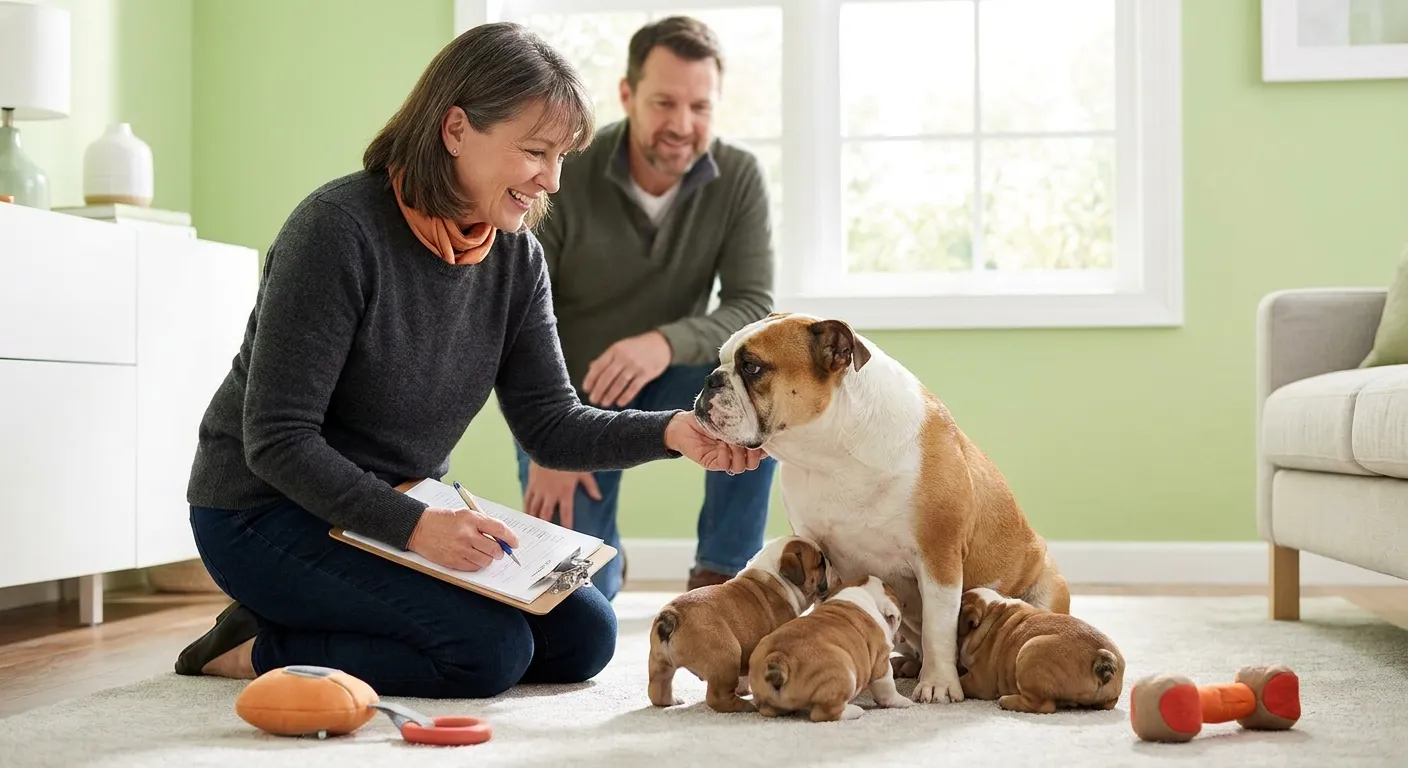
During the visit, ask where the puppies normally rest, eat and spend supervised time. Observe the actual environment rather than expecting a staged photograph to represent the entire routine. Look for safe access, suitable supervision and an explanation of cleaning and care. If something concerns you, write a specific observation and ask about it.
Let the puppy approach without forcing an interaction. Ask how it usually responds to people and handling, and compare the explanation with what you can reasonably observe. One meeting does not prove a future temperament. A shy or sleepy moment is a question to discuss, not a diagnosis or a reason to perform a stressful test.
Ask what early experiences the litter has had
Dogs Trust’s puppy-socialisation guidance describes gradual positive introductions and handling. Ask the breeder for examples of the litter’s experiences rather than accepting socialised as a complete description. Which ordinary sounds, people, surfaces and gentle handling have actually been introduced, and how did the puppies respond?
Request a practical handover note about the individual puppy. Useful information includes familiar food, rest arrangement, handling that it accepts and any experience that caused concern. A generic sheet for every litter can be a reference, but ask which details apply to the puppy you are considering. Do not assume that exposure alone guarantees comfort.
Ask how to continue the familiar routine when the puppy comes home. Public outings and contact with other dogs need a veterinary health plan, so do not copy a breeder’s general timetable without discussing the individual puppy and local risks. Your first appointment can combine the handover information with the vet’s assessment.
Read the proposed agreement before paying
Request the exact written terms, including the puppy’s identification, what is included, payment conditions and any stated health-related process. Read them away from the excitement of the visit. A verbal description of a guarantee is not the same as the document you are asked to accept. Keep unanswered terms visible.
Ask what happens if your vet identifies a concern, which notifications or records the seller requires and who bears responsibility under the stated terms. This guide does not interpret a contract or promise that a clause is enforceable. If the answer is unclear or consequential, obtain appropriate legal or consumer advice before proceeding.
Discuss ongoing contact and what support is offered if circumstances change. Ask for the process rather than assuming lifelong help from a friendly conversation. Keep the response with the agreement. A clear support arrangement is useful information, but it is still separate from an assessment of the animal’s health.
Prepare the veterinary handover
Ask for the puppy’s existing veterinary records and any treatment or preventive-care documentation. Give these to your own clinic so it can determine the next steps. Do not repeat a medicine or change a dose from a breeder’s casual recommendation. The clinician should know exactly what has already been given and when.
Prepare a collection-day checklist: identification documents, supplied records, food details, the signed agreement and contact information. Ask about suitable transport and arrange the first veterinary visit. If a document promised earlier is still missing, decide whether the unanswered question affects your willingness to proceed rather than assuming it will arrive later.
Make the decision from verified information
Review your contact sheet and mark each major question answered, unverified or unresolved. A documented health assessment, a useful handover and an understandable agreement give you specific information to evaluate. They do not guarantee a problem-free future. You can postpone the decision or walk away when an important question remains unanswered.
Choosing a Responsible Bulldog Breeder means making the buying process reviewable. Begin with veterinary questions, match health records to the parents, observe the actual care environment and read the terms before committing. The next useful action is obtaining and interpreting a missing document, not relying on a promise that any puppy is certain to be healthy.